How to Market Medical Devices to Orthopedic Surgeons by Email

Orthopedic surgeons are some of the hardest people in medicine to get time with. Their days are split between the OR, clinic and call, and the device reps who used to own the relationship now share influence with hospital purchasing teams. If you sell implants, instruments, biologics, imaging or software into orthopedics, email is one of the few channels that reaches a surgeon on their own schedule. It works only when the message is specific, useful and sent to the right subspecialty.
This guide covers who actually influences orthopedic device decisions, how to segment surgeons, what to send, and the rules to follow before you hit send.
The short answer
To market medical devices to orthopedic surgeons by email, segment by subspecialty and practice setting, lead with clinical evidence and education rather than a sales pitch, and plan for the hospital value analysis committee as well as the surgeon. Keep sequences short, time them around the surgeon’s calendar (including the AAOS Annual Meeting), and follow CAN-SPAM and Open Payments rules.
Why orthopedic surgeons are a distinct audience
The audience is smaller than most marketers assume. A 2026 AAOS Now report on Centers for Medicare & Medicaid Services data counted an average of about 23,700 practicing orthopaedic surgeons per year from 2018 to 2023. With a pool that size, every wasted send to the wrong surgeon costs you reputation as well as money.
The audience is also highly specialized. A spine surgeon, a hand surgeon and a sports medicine surgeon use different devices, read different journals and respond to different evidence. A single “orthopedic” campaign treats them as one buyer, and most of them will ignore it.
Who influences an orthopedic device decision
The surgeon is rarely the only decision maker anymore. Hospitals have formed value analysis teams or committees that review which implants are allowed in the facility and at what price, as OrthoWorld describes. The surgeon is still essential, because a committee usually acts on a surgeon’s request and evidence, but your marketing has to equip that surgeon to make the case.
| Stakeholder | What they care about | What to send them |
|---|---|---|
| Orthopedic surgeon | Outcomes, technique, ease of use in the OR | Clinical data, technique guides, short case reviews |
| Value analysis committee | Clinical value, total cost, standardization | Evidence summaries, cost and reimbursement information |
| Ambulatory surgery center (ASC) administrator | Case cost, turnaround time, inventory | Per-case cost breakdowns, logistics and consignment options |
| OR and sterile processing staff | Setup time, instrument trays, training | Setup checklists, in-service and training offers |
| Practice manager | Scheduling, billing, staff time | Workflow and billing resources |
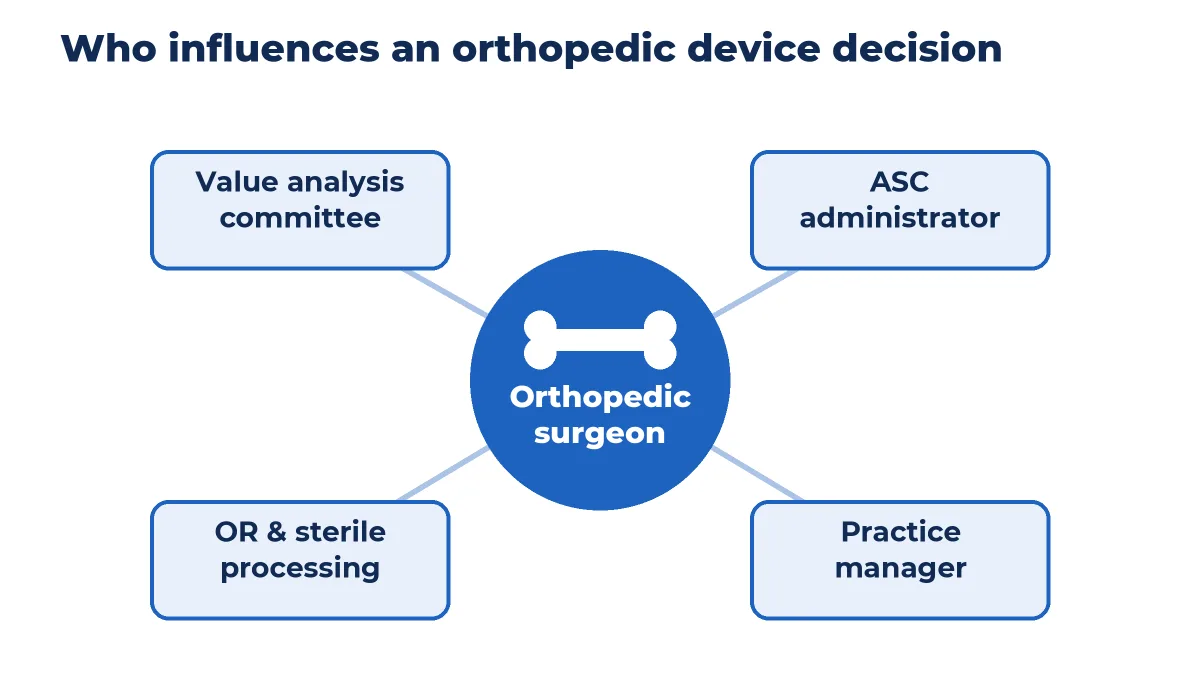
The practical takeaway: build separate tracks. Surgeons get clinical content. Administrators and committee members get cost and operational content. A good medical device marketing database strategy maps the people around the surgeon, not just the surgeon.
How to segment orthopedic surgeons
Segmentation is where most orthopedic campaigns succeed or fail. Start with these layers.
Subspecialty
Match the device to the surgeons who use it: joint replacement (hip and knee), spine, sports medicine and arthroscopy, shoulder and elbow, hand and upper extremity, foot and ankle, trauma, and pediatric orthopedics. A knee implant message sent to hand surgeons tells them you did not do your homework.
Practice setting
Hospital-employed surgeons, private group surgeons, academic surgeons and surgeons who operate in ASCs face different purchasing processes. Academic surgeons may care about research and training; ASC-based surgeons often care more about per-case cost and efficiency.
Geography and territory
Line up email segments with your sales territories so reps can follow up. Competitive presence also varies by region, so the same message may need different proof points in different markets.
Role and influence
Flag surgeons who chair departments, sit on value analysis committees or teach residents. They shape what others adopt, so they deserve more personalized outreach.
Target Access Hub’s orthopedic surgeons email list can be segmented by subspecialty, such as knee and hip replacement, spine, and shoulder arthroscopy, and by location.
What to send: education beats selling
Surgeons get a steady stream of promotional email. The messages that earn a reply give them something useful in under a minute. Strong formats include:
- A one-page summary of a peer-reviewed study, with the citation and a link to the full paper.
- A short technique video or annotated surgical steps.
- An invitation to a cadaver lab, webinar or booth demonstration.
- A value analysis packet the surgeon can forward to the committee.
- A case review written with, and approved by, a consulting surgeon.
Keep the subject line plain and specific, for example “Two-year outcomes: cementless knee in active patients.” Avoid hype; surgeons are trained to discount claims without data.
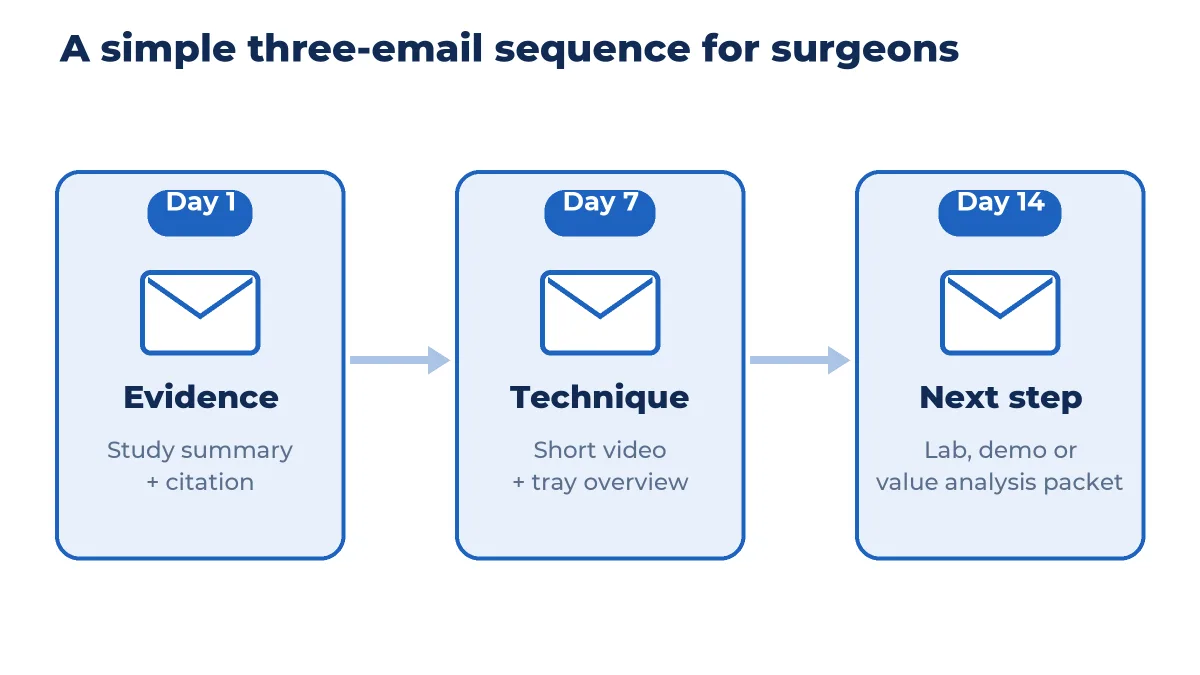
A sample three-email sequence
Here is a simple sequence for introducing a new knee system to joint replacement surgeons. Adjust the timing to your sales cycle.
| Timing | Goal | Content | |
|---|---|---|---|
| 1. Evidence | Day 1 | Earn attention | Two-paragraph study summary, citation, link to the paper |
| 2. Technique | Day 7 | Show how it works in the OR | Short technique video and instrument tray overview |
| 3. Next step | Day 14 | Start a conversation | Offer a lab, demo or value analysis packet, plus a direct reply option to the local rep |
Stop the sequence for anyone who replies or opts out, and hand engaged surgeons to the territory rep quickly.
Time your campaigns around the surgeon’s calendar
Conference season is the biggest timing lever. The AAOS 2027 Annual Meeting runs March 3 to 6, 2027, in Las Vegas, with the exhibit hall open March 3 to 5. Use January and February for pre-meeting invitations to booth demos or labs, and the weeks after the meeting for follow-up with surgeons who stopped by.
Outside conference season, avoid early-morning sends when surgeons are in the OR, and test late-afternoon and weekend sends for your own audience.
Compliance basics before you send
Two sets of rules matter most. This is general information, not legal advice; check with your compliance team.
- CAN-SPAM Act. Commercial email needs accurate header information, a subject line that is not deceptive, your valid physical postal address and a working opt-out that you honor within 10 business days. See the FTC’s CAN-SPAM compliance guide.
- Open Payments (Sunshine Act). Applicable manufacturers of covered devices must report certain payments and transfers of value to physicians, such as meals at a lab or event, to CMS. Learn more at CMS Open Payments.
Clean data also protects deliverability. Remove bounces and opt-outs after every send, and refresh your list on a regular schedule with data appending and cleansing.
Checklist for your next orthopedic campaign
- Define which subspecialties actually use the device.
- Split surgeons from administrators and committee contacts.
- Prepare one piece of clinical evidence and one cost or workflow asset.
- Write a three-email sequence with a clear next step.
- Line up sends with territories and the conference calendar.
- Confirm CAN-SPAM elements and Open Payments tracking.
- Track replies and meetings, not just opens.
For broader context on reaching clinicians, see our healthcare email marketing guide.
Frequently asked questions
Is email effective for reaching orthopedic surgeons?
Yes, when it is targeted and useful. Surgeons can read email between cases or after clinic, which makes it easier to reach them than in-person visits. Messages built around clinical evidence for their subspecialty perform far better than generic promotions.
Who decides which orthopedic implants a hospital buys?
Most hospitals use a value analysis committee that reviews new products for clinical value and cost. Surgeons usually request a product and present the evidence, while the committee, supply chain and administrators approve it. Plan content for both groups.
How should I segment an orthopedic surgeons email list?
Start with subspecialty, such as joint replacement, spine, sports medicine or trauma. Then add practice setting, geography and the surgeon’s influence, for example department chairs or committee members.
When is the best time to email orthopedic surgeons?
Avoid early mornings when many surgeons are operating, and test late-afternoon sends for your audience. Plan bigger campaigns around conferences, especially the weeks before and after the AAOS Annual Meeting.
Do I need to report anything when I market to surgeons?
Email itself is not reportable, but some things you offer may be. Under CMS Open Payments, applicable device manufacturers report certain payments and transfers of value to physicians, such as meals. Your emails must also follow CAN-SPAM.
Reach the right orthopedic surgeons
If you are planning an orthopedic launch or territory campaign, our data team can build a list segmented by subspecialty, setting and location. Get a quote and tell us which surgeons you need to reach.